



AI governance is the foundation for any company that wants to introduce AI into its own processes in a sensible and controlled way. AI governance describes the rules, roles and processes you use to manage the use of AI.
The topic is especially relevant right now: many companies are evaluating assistants, knowledge search or document analysis, and quickly run into questions around responsibility, approvals, data, quality and operations.
This article takes a practical look at how decision-makers can build robust AI governance without drifting into technical detail. It is aimed at managing directors, IT managers, business departments and project leads in small and medium-sized businesses, public sector organisations and agencies in German-speaking countries.
This is not about abstract mission statements, but about a workable organisational model for AI in existing processes and software solutions. If, alongside this overview, you are also looking for an overview of relevant services, a rough cost range, a project brief, a no-obligation initial consultation or insights into different types of project, you will find suitable starting points there.
What AI governance in a company needs to achieve
Within a company, AI governance is a practical framework of responsibilities, rules, reviews and technical guardrails for the use of AI. It defines how a use case is assessed, approved, operated and, where necessary, adapted.
The key point is this: governance should not only limit risk. It can also speed up decision-making. If it is clear who assesses an idea from a business perspective, who checks technical feasibility and which criteria are used for approval, there are fewer follow-up questions and less friction between business teams, IT and management.
Typical areas of use include:
- searching company knowledge
- assistants for internal processes
- extracting information from documents
Without this kind of framework, AI initiatives often stall at an early stage. Common reasons include unclear objectives, inconsistent data sources, missing approval processes, uncertainty when assessing results and one unresolved question: who is responsible once the solution is live?
Companies should clearly separate business governance from technical implementation. The business side assesses commercial value, suitability for the process and permitted use. IT is responsible for integration, security, operations and traceability. Here, traceability means that decisions, data sources and changes can later be reviewed and understood.
“Guardrails” are deliberately defined limits that specify what AI may be used for, which data it may access and when people must step in.
Roles, responsibilities and decision paths
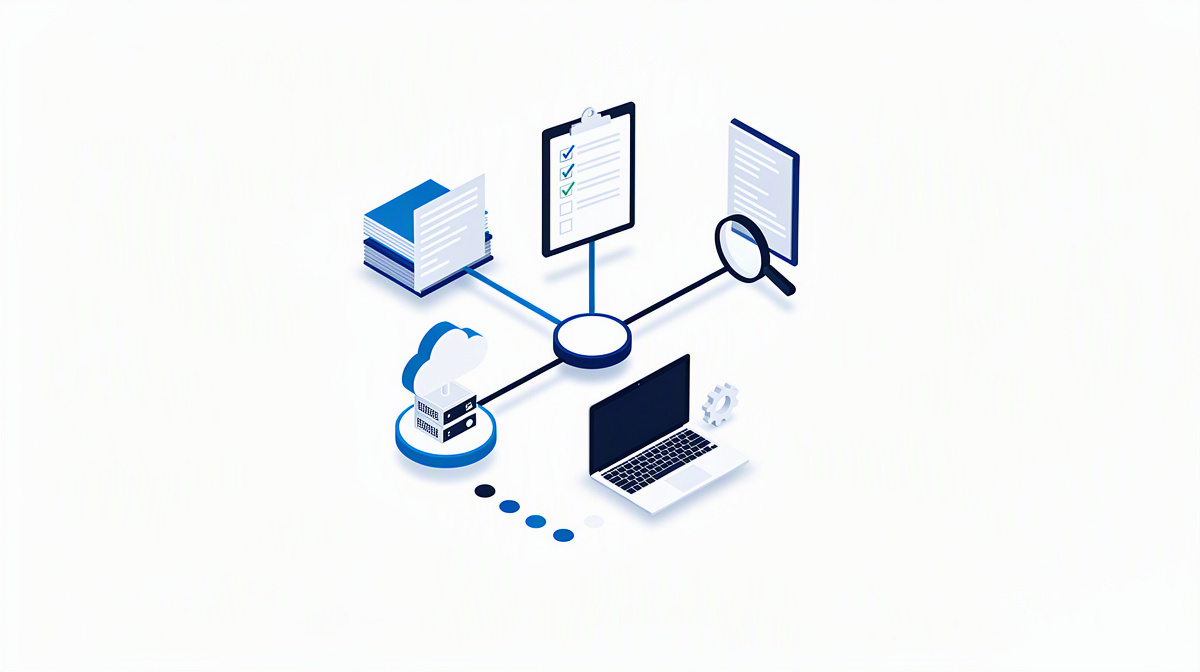
AI governance should not be set up as an IT issue alone. It only becomes sustainable when management, IT and the affected business departments jointly define which use cases make sense, how decisions are taken and who carries responsibility in day-to-day operations.
In practice, a small number of clearly defined roles has proved effective:
- a business sponsor who describes the commercial need
- IT leads who assess integration, security and operations
- a person responsible for the project who coordinates alignment and delivery
- a designated approval function that decides on the pilot and live use
There should also be a business owner for each AI use case. This person documents the objective, the expected benefit and the permitted use. That makes it clear at an early stage what the solution is intended for, where its limits lie and who decides if questions arise.
Decision paths should be kept deliberately simple: idea, initial assessment, pilot, approval for live use. A “pilot” is a limited real-world test that companies use to assess benefit, quality and effort before broader adoption.
To avoid each new idea being judged on gut feeling, fixed prioritisation criteria are helpful. These might include expected benefit, data availability, organisational effort and the consequences of incorrect results.
As soon as data protection, contractual issues or sector-specific requirements come into play, an internal or external review is advisable. Companies should involve their data protection officer or legal adviser for this.
In day-to-day practice, AI governance only works if responsibilities are documented in writing and embedded in existing project and approval processes.
Rules for data, quality and live operation
AI is only as reliable as the data and sources it can access. That is why AI governance needs clear rules on which data sets are permitted for a given use case and which are not. Without this boundary, contradictory answers, outdated results or uncertainty about what the AI is actually based on can quickly arise.
Before starting, companies should settle a few basic questions as binding decisions:
- What information may the system use?
- How up to date is that information?
- Who maintains the content and is responsible for its quality?
- Who may see or reuse the results?
“Live operation” means use in day-to-day business, outside an internal test or pilot.
It also makes sense to define quality standards in advance. These include, for example:
- clarity of the answers
- business plausibility
- completeness
- traceability of the sources used
Criteria like these help results to be assessed systematically rather than just on first impression. Especially in assistants, knowledge search or document analysis, it should be clear when a result is good enough and when it needs improvement.
Where AI outputs directly affect decisions, customer communication or operational processes, human oversight should be mandatory. That keeps it clear when a business review is required and who is responsible for it.
For many companies, it is also important that data is processed within their own Azure environment in the EU. How this should be assessed in a specific case should be reviewed internally with the relevant stakeholders, such as the data protection officer.
Finally, governance also includes a defined approach to errors: how are issues reported, assessed and corrected, and when should they trigger changes to the use case itself?
From idea to a robust AI solution
A practical way into AI governance does not start with a large programme, but with a clearly defined use case. A sensible project is one that has an obvious benefit and remains manageable from an organisational point of view. Before development begins, you should define the objective, data basis, responsible parties and success criteria.
A sensible delivery path then includes these steps:
- clarify requirements
- develop the concept
- build the solution
- assure quality
- put it live
- then continue to develop it
This creates not an isolated test, but a solution that fits into existing processes. That is exactly where it becomes clear whether governance works in practice: are sources approved, responsibilities assigned and criteria for good results agreed?
A typical example is an AI-supported search across company knowledge or an assistant for internal processes. Employees find information from existing sources more quickly when it has already been defined which content may be used, who maintains it and how results are checked.
Terms such as Azure OpenAI or Entra ID matter to decision-makers above all in one respect: the AI function is integrated into existing Microsoft environments, identities and access rules.
Anyone planning implementation and operations for a web, app or database solution alongside governance should consider these questions together from the outset.
Which technical guardrails matter in the background

For AI governance in a company, technical guardrails are especially relevant when new functions are to be integrated permanently into existing processes. This is not about development detail, but about understandable rules for identities, access, versions and handover into operations.
One important point is a clean separation of environments. Development, testing and live operation should not be mixed. This makes it possible to check changes before they affect day-to-day work.
A clearly defined approach to versions and changes is just as important:
- What change was made?
- Who approved it?
- Which data sources or processes are affected?
- How is it checked that the result still fits day-to-day use?
There is also the technical integration with existing systems. When AI functions connect to Microsoft 365, Entra ID, SQL databases or existing line-of-business applications, permissions and data flows remain easier to control.
In projects by ballmüller solutions, this point is visible beyond AI as well, for example in an extension that links Azure DevOps with planning software. For companies, the main thing is this: the solution should not run off to the side, but move in an orderly way into existing operations.
Frequently asked questions about AI governance
What does AI governance in a company include?
It does not mean abstract principles, but concrete arrangements for day-to-day work. At its core, AI governance includes:
- clear objectives for each use case
- named responsible parties
- rules for permitted data and sources
- approval and review processes
- quality criteria for results
- requirements for operations, changes and error handling
It is only the combination of these points that makes AI manageable within a company.
Who should be responsible for AI governance?
Responsibility should not sit with a single function alone. What works best is an interaction between management, IT and the business department. The business department assesses benefit and permitted use. IT is responsible for integration, access and operations. In addition, there needs to be a designated function that decides on the pilot and live use. There should also be a defined business owner for each use case.
How do I start AI governance without launching a major programme straight away?
Start with a manageable use case. In a short form, define:
- which problem is to be solved
- which data may be used
- who decides and gives approval
- how you will recognise usable results
- how errors will be handled
This creates a solid framework that you can later apply to further cases.
What role do data and permissions play in AI governance?
They play a central role because quality and reliability depend directly on them. If unclear, outdated or unapproved sources are used, incorrect or misleading results quickly follow. It is just as important who is allowed to see what. Permissions define which people can access sources, functions and results. Governance should therefore explicitly regulate data sources, maintenance responsibility and access rights.
When should an AI use case be reviewed by a person before live use?
Whenever the results have consequences beyond an internal test. This applies in particular when AI:
- prepares or influences decisions
- supports external communication
- controls operational processes
- summarises content from several sources that must be assessed from a business perspective
Human review is also advisable when the impact of errors is high or the data situation is inconsistent.
How to get started with robust AI governance
AI governance becomes effective when objectives, responsibilities, data rules, quality criteria and operational processes are considered together. Only then does a framework emerge that works in day-to-day practice.
A good next step is simple: describe your planned use case in a few sentences and derive the open points from that:
- What benefit should it deliver?
- Which data may be included?
- Who reviews and approves it?
- How will operations be organised?
ballmüller solutions supports the conception, development, quality assurance, go-live, support and further development of bespoke software with AI functions in the Microsoft Cloud.