


Anyone searching for a "functional specification example" usually wants more than just a template. They want to understand how requirements become a reliable plan for a software project. That is exactly what this article helps with: it explains the purpose of a functional specification, a practical structure, typical contents and common mistakes in tenders and supplier enquiries.
It is aimed at managing directors, IT managers, business departments and project leads who want to have software newly developed, replaced or extended. The text is deliberately neutral, practical and free of technical detail. Each technical term is explained clearly in a single sentence.
If you are planning the next step afterwards, you may also find an overview of our services, a rough cost range, a project outline based on your documents, an initial no-obligation consultation and insights into completed projects helpful.
What a functional specification is meant to achieve
A functional specification describes a software project from the implementation perspective. It translates requirements into a concrete description of how the planned solution should be structured, which functions it must cover and which business rules apply.
It is important to distinguish it from a requirements specification:
- The requirements specification describes the goal, need and requirements from the client's perspective.
- The functional specification describes the planned implementation from the contractor's perspective.
Particularly in tenders and supplier enquiries, the document creates a shared working basis. Business teams, IT, procurement and the external supplier can all discuss the same assumptions, terms and priorities.
Its value is especially clear when preparing decisions. Quotations, follow-up questions and proposals become easier to compare when functions, interfaces and dependencies are clearly described. Interfaces are defined transfers of data between applications.
At the same time, a functional specification reduces misunderstandings. Unclear wording, missing exceptions or conflicting expectations are identified earlier, before they cause friction during implementation.
A functional specification is not an end in itself. Its purpose is to make the project manageable and decisions easier, not simply to produce documentation.
The level of detail should match the size of the project: for smaller initiatives, a leaner version is often enough, while more complex projects need more structure. If you mainly want to assess the actual implementation of web applications, apps, databases, interfaces, as well as hosting and operations, this translation work is particularly important.
Functional specification example: how a useful structure is organised
A useful functional specification example does not just show headings, but a clear logic. As a running example, imagine a web platform that allows an organisation to manage information, processes and documents in one place. This kind of example makes it easy to see which sections a functional specification should contain.
1. Current situation and target vision Start by describing the current situation: what problems exist, which processes are affected and what goal the new software is meant to achieve. This makes it clear why the project is starting in the first place.
2. Users and roles Record who will work with the system. Roles are groups with different tasks and access rights. Typical questions are: who may create data, who may check it, who may approve it and who may only read it?
3. Scope of functions Then come the key functions, ideally described as understandable use cases. For example:
- Capture data
- Search and filter information
- Approve content
- Create reports
- Export results
This keeps the functional scope tangible rather than too general.
4. Data and objects Specify which information will be managed in the system. This also includes how the data relates to each other and which entries are mandatory fields. Without this section, many requirements remain unclear.
5. Interfaces Explain which other systems need to be connected. Interfaces are defined transfers of data between applications. What matters here is not only the target system, but also which data flows in which direction.
6. Processes and rules This section describes which workflows the software should support and which business conditions apply. This includes approvals, checking steps or dependencies between processing states.
7. Non-functional requirements Finally, the document should cover the properties of the solution: usability, availability, performance, logging and maintainability. Non-functional means it is not about individual features, but about the quality and way the solution operates.
What is often missing – and can become expensive later

Many early project documents do not fail because they contain too little text, but because they have the wrong gaps. Typical issues are unclear objectives, missing priorities, overly general wording and exceptions that are not described. If, for example, all it says is that a solution should be "easy to use" or "flexibly extendable", it remains unclear what that actually means in day-to-day use.
Prioritisation is particularly important. Not every requirement carries the same weight. A visible order helps distinguish core functions from later enhancements and prepares decisions during implementation more effectively.
These points are also often considered too late:
- Data migration: If a legacy system is being replaced, it should be clear which data is to be transferred and in what quality it exists.
- Permissions: Roles, approvals and visibility rules shape many solutions more strongly than it first appears.
- Reports and exports: Reports, lists and file exports are often only mentioned later, but are frequently crucial in day-to-day business use.
- Interfaces: It should be clear early on which third-party systems are involved and who the technical contacts are there.
- Operations: Responsibilities for cloud operations, updates, monitoring and recovery in the event of a fault should be clarified early. Monitoring means the ongoing supervision of the technical state.
If AI functions are planned, they should be described as a separate block of requirements. This applies, for example, to knowledge search, assistants or document extraction. The key points here are data sources, expected results and review processes.
How the document becomes a reliable project plan
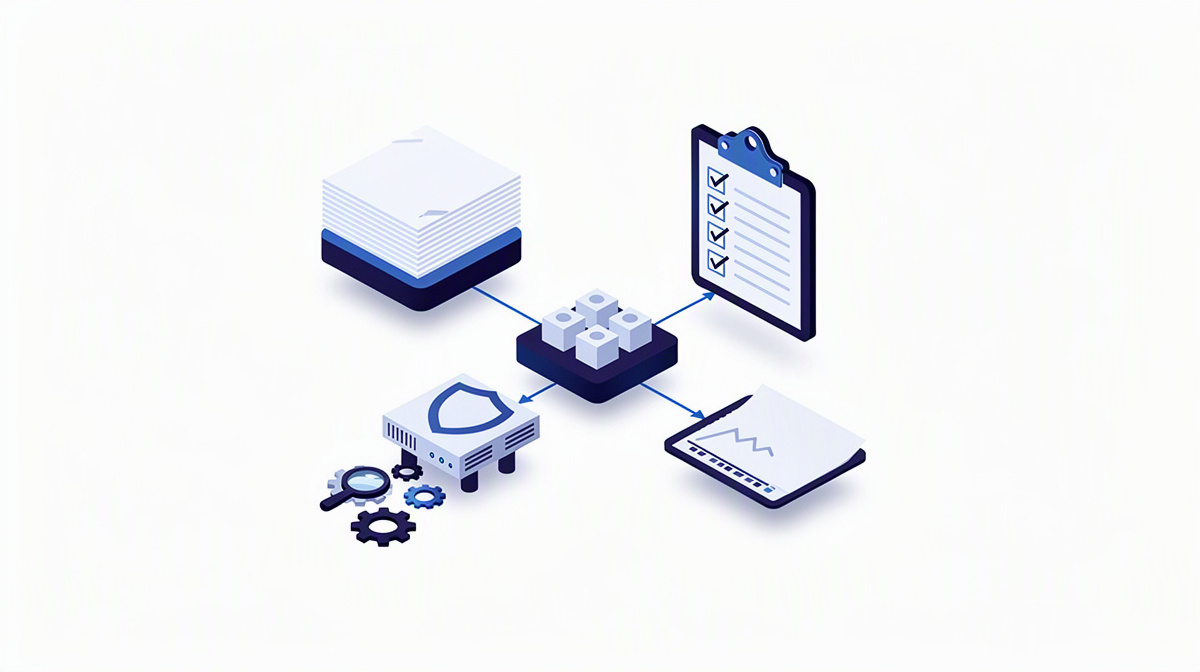
A good functional specification does not end with writing it. It serves as the working basis for further project organisation and translates business requirements into a process that can be managed and coordinated.
A sensible next step is to move into clear project phases:
- Refine requirements
- Align concept and design
- Plan implementation
- Check quality
- Go live
- Develop further
What matters is that assumptions and open points become visible before implementation starts. Otherwise, gaps quickly turn into unspoken expectations that lead to discussion later.
The requirements are then turned into work packages. Larger topics are broken down into understandable units that can be prioritised, coordinated and checked. This keeps it clear what matters first and what can follow later.
Regular coordination also helps to keep checking the shared understanding. Business teams and the supplier can see early on whether objectives, terminology and solutions still fit together or whether corrections are needed.
Quality assurance includes systematically checking whether functions, workflows and data work as agreed. Structured development, automated tests and controlled delivery help to implement changes in a managed way. CI/CD means that software changes are checked and deployed in a standardised manner.
If you would like to derive an initial rough cost range from your functional specification, the cost calculator can be a sensible next step.
How to recognise a useful functional specification before sending an enquiry
Before you send your document, a short self-check is worthwhile. The following checklist helps identify typical weaknesses early.
- Is the target vision understandable? The direction of the project should be clear even without additional background discussions.
- Are user groups, core processes and main functions clearly described? Readers should understand who works with the solution and what it is meant to achieve from a business perspective.
- Are the boundaries visible? It should be explicitly clear what is not part of the project.
- Are external systems, data sources and dependencies named? This also includes assumptions that are relevant for implementation.
- Are there understandable criteria for business fit? This means characteristics that make it possible to judge whether the solution meets the requirement.
- Are open points clearly marked? Unresolved topics should be highlighted rather than getting lost in the text.
It is also sensible to review the document jointly between the business side and IT before sending the enquiry. This makes it easier to align language, expectations and priorities.
Frequently asked questions about the functional specification
How long should a functional specification for a software project be?
There is no sensible standard length. What matters is not the number of pages, but whether the document describes the business-critical points clearly and in sufficient detail. For a smaller project, a compact version is often enough. Where there are several user groups, interfaces, approvals or complex workflows, the functional specification needs more structure.
A good rule of thumb is: as concise as possible, as specific as necessary. If readers can confidently understand the target vision, functions, data, roles, boundaries and open points, the document serves its purpose.
Do I already need a complete functional specification for a supplier enquiry?
No. For an initial enquiry, a fully developed functional specification is not strictly necessary. A clear description of the objective, the desired functional scope, known interfaces and recognisable constraints is often enough.
What matters above all is that uncertainties are not hidden. An incomplete but honest document is better than one that appears complete but contains many silent assumptions.
What is the difference between a requirements specification, a functional specification and a project outline?
The terms describe different levels:
- Requirements specification: What is needed and which goal is to be achieved.
- Functional specification: What the planned implementation should look like in order to achieve this.
- Project outline: A condensed short version that makes the framework of a project quick to grasp.
A project outline does not replace a complete functional specification, but it can provide a good basis for initial discussions and an initial assessment of the project.
Who in the company should approve a functional specification?
It should not be approved by just one party. A joint view from the following is advisable:
- Business department
- IT
- Project lead
- Procurement or tendering, if required
This ensures that business objectives, technical dependencies and formal expectations fit together.
Can a functional specification still be changed later?
Yes. A functional specification is a working basis, not a rigid document. Changes are normal in software projects when new insights emerge or assumptions are reviewed.
What matters is documenting adjustments consciously: what is changing, why it is changing and what consequences this has for scope, priorities or boundaries. That is exactly what keeps the project manageable.
From functional specification to the next sensible step
A good functional specification is not a formality. It forms the bridge between a business requirement and a project plan that can be implemented and managed in a transparent way.
It becomes truly useful when these points are clearly described:
- Target vision
- Roles
- Functions
- Data
- Interfaces
- Operations
- Quality assurance
- Boundaries
Even incomplete documents can already provide a good basis for this, as long as open points are clearly marked.
ballmüller solutions has supported custom software projects with Microsoft .NET for over ten years, from web applications and portals to apps, databases and interfaces through to operations in Azure. If you would like to assess your project, you can request an initial no-obligation consultation via Microsoft Teams. Your contact is Managing Director Görkem Ballmüller. Alternatively, a project outline can be created from a description or a requirements specification.