


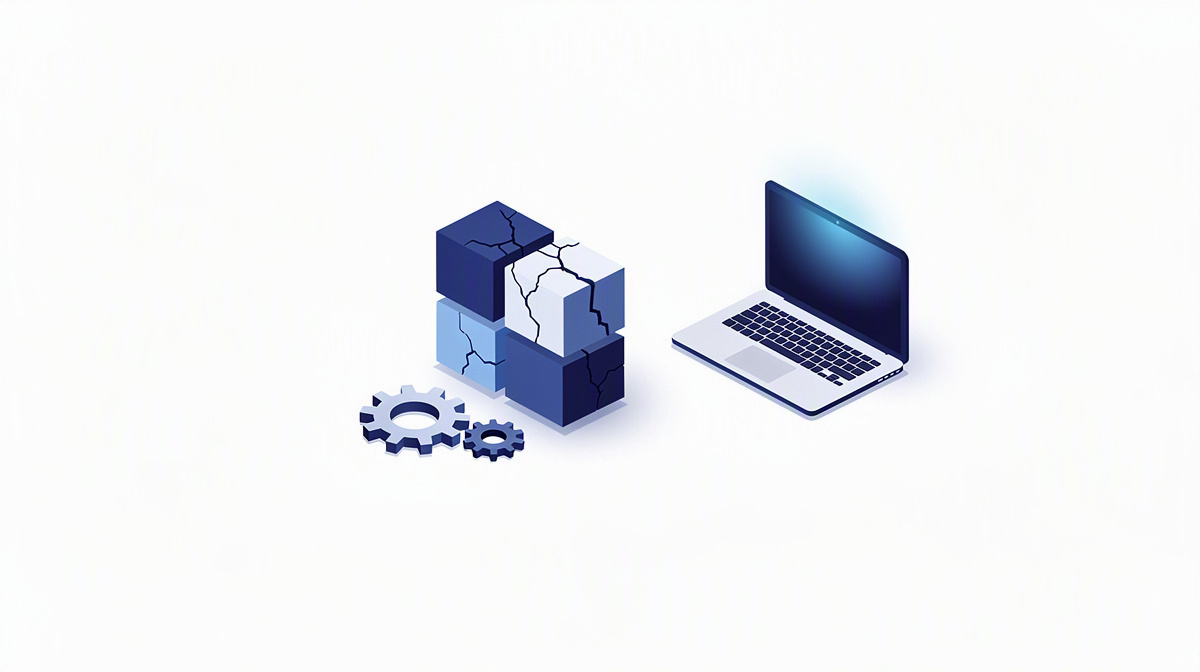
Technical debt is a term that often comes up when mature software becomes a noticeable drag in day-to-day work. Put simply, it means shortcuts, temporary fixes or outdated solutions were accepted in the past, and those decisions now make changes expensive, slow or risky.
For you as an IT manager, managing director or project lead, the issue usually becomes concrete when an existing line-of-business application starts reaching its limits, for example in extensions, interfaces, security, usability or operations. This is exactly where a clear-eyed view of its condition and the consequences helps.
This article explains the term in practical terms, shows typical warning signs and helps you decide whether improvements, gradual modernisation or an orderly rebuild make sense.
What technical debt means in practice
Technical debt is not a financial term in the strict sense, but a way of describing the long-term consequences of earlier technical decisions. In other words, a solution may still work, but over time it becomes harder to change, extend or operate securely.
This kind of debt often builds up gradually, for example when quick fixes are implemented under time pressure, planned clean-up work is postponed, or systems are continually extended over many years. At first, that is not unusual. Not every pragmatic decision is a problem. It only becomes critical when the knock-on costs of changes keep rising over time.
A typical distinction is the one between visible business functionality and the invisible technical foundation:
- Users see what the application can do from a business point of view.
- The company feels how much effort further development actually involves.
These burdens often accumulate over many years, especially in long-established Access solutions, old desktop applications or older web applications. The term does not just refer to source code, but also to data structures, interfaces, documentation, tests, permissions and operating processes. An interface is the defined connection between two systems through which data or functions are exchanged.
If you would like to explore documentation in more depth, see the article on technical documentation. For an overview of the role of tests, see the article on software testing in projects.
Technical debt is therefore usually not a single mistake, but a condition that may have arisen from many small decisions.
How to recognise technical debt

You often recognise technical debt not through one major outage, but through lots of small points of friction in everyday work. A typical sign is when even manageable changes trigger a disproportionate amount of coordination, rework or troubleshooting. In that case, it is not the business requirement that is large, but the path to implementation that has become unnecessarily difficult.
Another warning sign is postponed releases because nobody can reliably assess what side effects an adjustment might have. That often points to a fragile technical foundation. Fragile here means that a change in one area can cause unexpected problems elsewhere.
In day-to-day operations, these conditions often show up very clearly:
- Data is maintained in parallel in several places.
- Breaks between systems and departments arise.
- Exports and imports run manually.
- Special logic exists, but is difficult to follow.
It also becomes critical when only a few people really understand how the application works internally. Then important knowledge remains tied to individuals. If those people are unavailable or move to other tasks, risk and dependency increase. Missing or outdated documentation makes this worse.
There is also technical obsolescence: the application may still run, but can only be adapted to new requirements, devices or operating models with difficulty. As soon as mobile use, modern web interfaces, integration with Microsoft 365 or central sign-in via Entra ID is required, legacy software often first reaches organisational limits and then technical ones.
If you would like to derive the need for modernisation from this, a first overview of typical services, a rough estimate via the cost calculator, a structured project check, a no-obligation initial consultation or insights into completed projects can help.
The impact technical debt has on companies
The most visible consequence of technical debt is rising effort for changes. Business departments wait longer for new functions, even though the business scope may seem manageable at first glance. What looks like a small adjustment from a business perspective becomes, technically, an undertaking with many dependencies, queries and uncertainties.
Over time, this widens the gap between what the business needs and what the existing application can reliably deliver. Requirements are left pending, implemented in simplified form or outsourced into side processes.
Operational risk also increases. Faults become harder to isolate because causes are not clearly documented or because several parts of the application have been tightly coupled. Corrections can then trigger unintended side effects.
Data quality also often suffers. When information is spread across several systems or processes are bridged with Excel, email and manual work, contradictions, duplicate maintenance and unclear data states arise more quickly.
For managers, the issue therefore often shows up not first as a technical one, but as an organisational problem:
- Processes become slower.
- Responsibilities are harder to assign.
- Transparency around status, data and ownership declines.
To make matters worse, changes become riskier without reliable safeguards. A test is a targeted check to see whether software shows the expected behaviour under defined conditions. If automated tests are missing, changes are harder to verify.
Technical debt ultimately also slows innovation. New portals, apps, reports or AI functions may make perfect business sense, but on an overburdened foundation they can often only be connected with considerable extra effort.
Which ways out of technical debt make sense

In practice, the choice is rarely just between “leave everything as it is” and “rebuild everything from scratch”. Between those two extremes there are often several sensible options that are a better fit for budget, risk, ongoing operations and business priorities.
That is why the first step is a sober assessment of the current state. What matters is not only how old an application is, but where it is specifically causing friction. Three questions are particularly relevant:
- Which processes are business-critical?
- Which parts of the application cause the greatest friction?
- What dependencies exist on databases, third-party systems and user groups?
On that basis, three paths can usually be distinguished: targeted remediation, gradual modernisation or orderly replacement.
Targeted remediation is suitable when the core business solution is still sound, but individual technical weaknesses are making operations or further development unnecessarily difficult. In that case, it can make sense to improve specific interfaces, data structures, permissions or testing gaps without calling the whole system into question.
Gradual modernisation is often the right fit when the data and business logic can still be used, but the user interface, architecture or integrations should be renewed. Architecture here means the basic structure of software and how its components interact. In such cases, it is often sensible to develop the application further in stages instead of replacing everything at once.
Orderly replacement is more appropriate when the existing solution is too far removed from today’s requirements in both business and technical terms, or when knowledge and documentation can hardly be relied on any longer.
In every case, it is important to plan the migration so that operations and business work are not put at unnecessary risk. Running some steps in parallel is often more sensible than a hard, complete switchover.
How to prepare realistically for a modernisation project
A modernisation project is easier to deliver if you do not view technical debt purely as a technical issue. In practice, it almost always also concerns business processes, responsibilities, operations and the question of how changes can be implemented sustainably in day-to-day work.
It therefore makes sense for business departments, IT and decision-makers to share a common view of goals, risks and priorities. That makes it clearer, earlier on, what really matters and where boundaries should be set deliberately.
Helpful guiding questions include:
- What must continue to work unchanged?
- What can be deliberately simplified?
- Which interfaces are essential?
- Which legacy burdens should not be carried over into the new solution?
It is just as important to classify topics such as data protection, accessibility or contractual requirements. These points should be reviewed for the specific project with a lawyer or data protection officer.
For an early assessment, it helps to summarise requirements in a structured short description or a requirements specification. If you are initially looking for a rough cost range, you can use the cost calculator. If you already have more material, you can have a project profile prepared from a description or a requirements specification, including follow-up questions and a cost range.
Common questions when you want to assess technical debt
Is technical debt just old code?
No. Old code can be an indicator, but it is not the actual definition. Technical debt describes a condition in which changes become unnecessarily time-consuming, error-prone or hard to plan. That can also happen in newer applications if a great deal has been added under time pressure without properly developing the technical foundation.
This includes, among other things:
- unclear data structures
- hard-to-understand special logic
- missing tests
- incomplete documentation
- laborious manual intermediate steps
So the decisive factor is less the age and more the question of how well the application can still be adapted and operated today.
When does technical debt become a real problem for a company?
It becomes a problem when it no longer affects only IT, but has a visible impact on processes, decisions and deadlines. That is usually the case when small changes become disproportionately large, or when important projects keep being postponed.
It becomes critical at the latest when:
- business departments wait a long time for adjustments
- knowledge depends on individual people
- interfaces only work via workarounds
- the risks of changes can hardly be assessed reliably any more
Then not only effort increases, but also dependencies and uncertainty.
Should a mature line-of-business application be modernised or completely redeveloped?
That depends on what in the existing solution is still viable. If the business logic, data foundation and core processes are still basically right, modernisation often makes sense. But if the structure, operating concept and technical foundation are all reaching their limits at the same time, an orderly redevelopment may be the clearer option.
A helpful question is: does it mainly need improvement, or does it need to be rethought in business and technical terms?
How can the scope of a replacement or modernisation be assessed sensibly in advance?
The best approach is a structured preliminary review. To do this, functions, interfaces, data sources, user groups and operational dependencies should be captured and prioritised together. That makes it visible which parts should be retained, simplified, replaced or rebuilt.
A reliable initial assessment usually does not require full detailed planning, but it does require a clear view of goals, risks and must-have requirements.
Tackle technical debt early instead of carrying it along
Technical debt does not usually resolve itself. It often only becomes visible when important changes are pending and the existing application starts to become a noticeable brake.
The earlier you assess the condition of mature software realistically, the more clearly you can classify risks, priorities and sensible next steps.
ballmüller solutions has been developing bespoke software with Microsoft .NET for more than ten years: web applications and portals, apps for all devices, databases, interfaces and operation in the Microsoft Azure cloud. Since 2022, the entire company has worked according to Clean Code Development.
One example from its own projects is a web platform on which municipalities manage their sewer network, its condition and planned measures in one place.
If you would like to assess a mature line-of-business application or structure a replacement or extension, a no-obligation initial consultation via Microsoft Teams is available. Further insights into completed projects can be found in the references.